What is paella? A Spanish definition (with all the regional honesty)

    By Blanca Bernabéu & Cristina Fernández · 2026-05-08

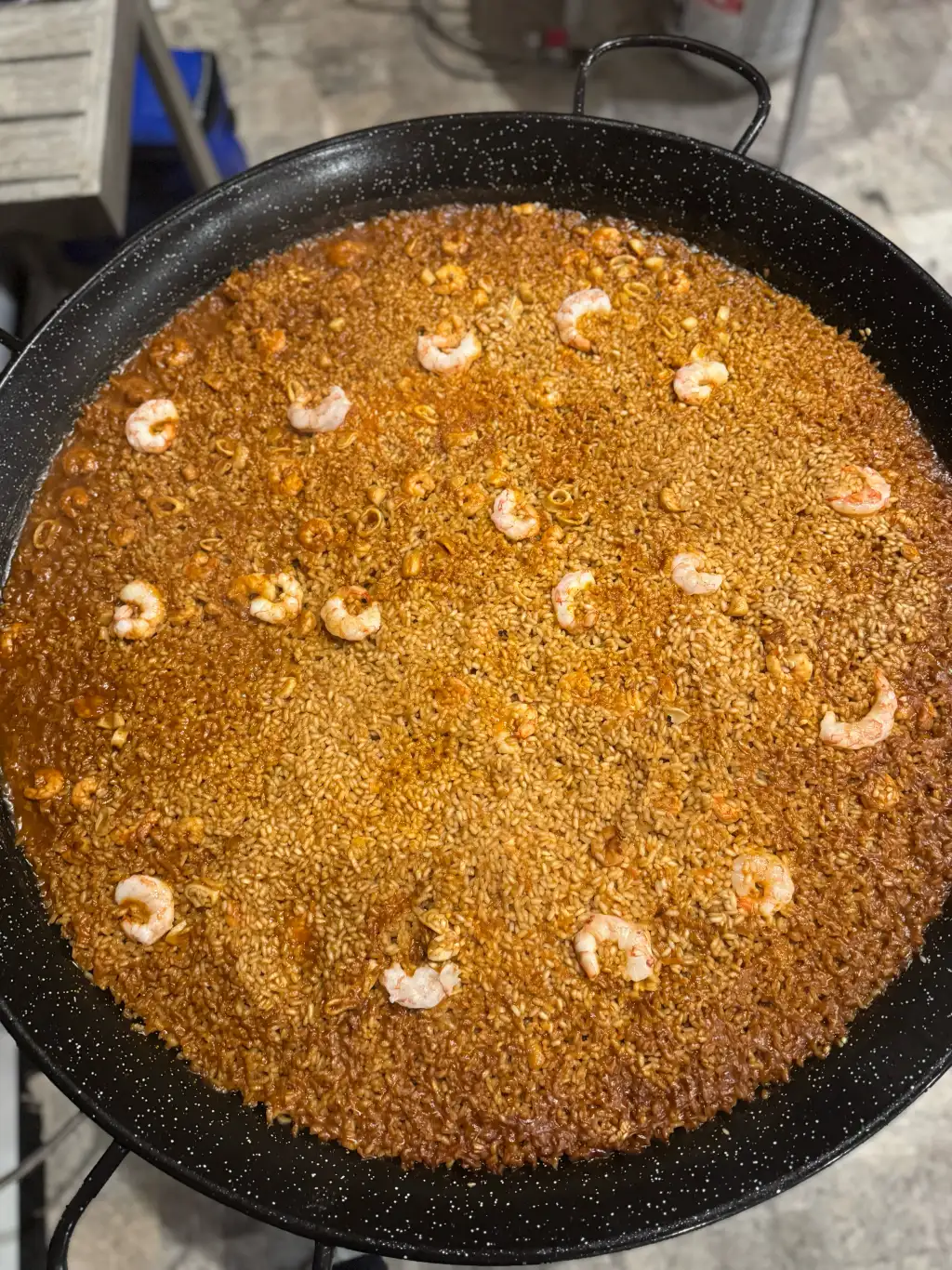
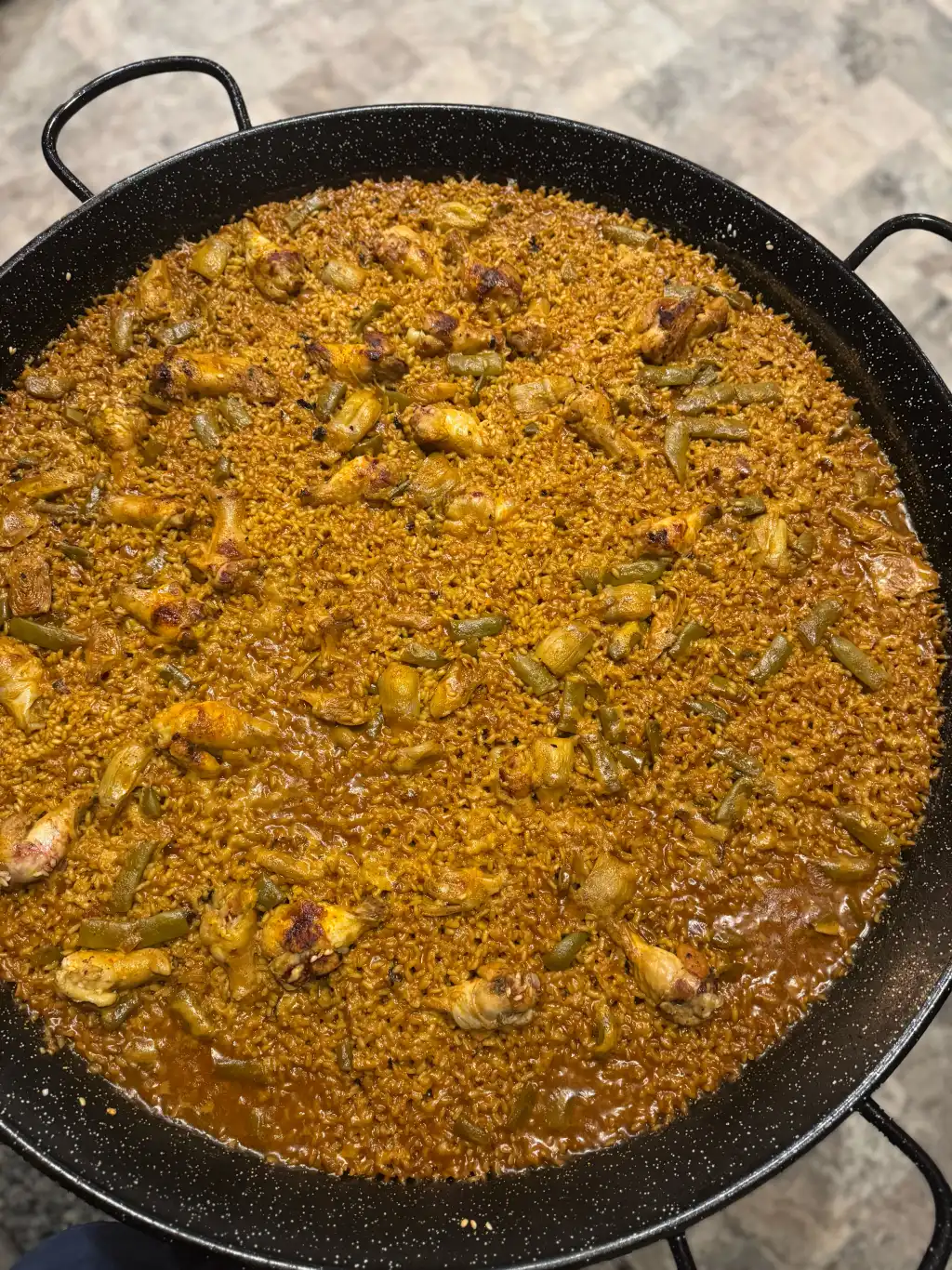
    Finished paella valenciana in a classic black paella pan, cooked live by Cantábrico in Houston

    Paella is rice cooked in a wide, shallow, two-handled pan over open flame, originally from the Albufera region of Valencia, Spain. The dish takes its name from the pan, not from any specific ingredient. The traditional version contains chicken, rabbit, green beans, garrofón, tomato, paprika, saffron, olive oil, Bomba rice, and water, and that's it. No chorizo. No onion. Almost certainly no seafood, unless you're east of Valencia and the rice is from a different recipe.

    We're Blanca (from Barcelona) and Cristina (from Asturias). We grew up next to the Mediterranean and the Cantabrian Sea, respectively. We cook paella now in Houston, Texas, for events. This guide is the explanation we wish someone had given us before we'd answered the question fifty times in the back of a kitchen.

    What paella is, and what it isn't

    Paella is, in the strictest definition, rice cooked in a paella pan. The pan is the wide, shallow, two-handled steel vessel, usually 14 to 36 inches across, designed to give the rice maximum surface area in contact with the heat. The shape is the dish.

    That definition is more useful than it sounds. It tells you what makes a paella a paella and what makes it something else.

    Most of what gets called "paella" in restaurants outside Spain is arroz con cosas, rice with things on top. That's a different category of dish. It can be very good. It just isn't paella, and pretending otherwise has consequences for what you'll get when you order it.

    The traditional Valencian recipe is specific: chicken, rabbit, green beans, garrofón (a flat white bean from Valencia), tomato, paprika, saffron, olive oil, Bomba or Calasparra rice, and water reduced into broth in the pan. Other regions adapted it, paella de marisco (seafood) on the coast, paella mixta (meat and seafood) in tourist areas, but every version that earns the name "paella" has rice cooked in the right pan, with the right technique, until the bottom layer caramelizes.

    If the rice came from a stockpot and got transferred to a serving dish, that isn't paella. If the pan never made it into the room, that isn't paella either. The pan is the dish.

    Where paella comes from: Valencia, the Albufera, and the 19th-century farmers

    Paella started in the Albufera region of Valencia, a freshwater lagoon south of the city, in the mid-1800s. The Albufera was, and still is, a major rice-growing area. Farmers and laborers cooked the noon meal in a wide pan over an open fire, using whatever the surrounding land had: rice from the paddies, rabbits and snails from the fields, beans from the kitchen garden, the occasional duck or chicken.

    The dish was a working-people's lunch. It wasn't a restaurant dish until the 20th century. It wasn't a tourist dish until the 20th century either. The way it spread out from Valencia followed Spanish migration: south along the coast, north through the rest of Spain, then across the Atlantic.

    The variations got more permissive as the dish moved away from its source. In Valencia, "paella valenciana" is a protected designation, the recipe is fixed by tradition, and the regional government has considered formalizing it. Outside Valencia, "paella" got applied to almost any rice dish cooked in a wide pan. Hence the chorizo issue, which we'll get to.

    The Albufera matters even when you're cooking somewhere else. The water, the rice variety, the open-air smoke, those are the constraints the dish was designed for. You can replicate the technique in a Houston backyard, but only if you respect what the technique actually does.

    What "paella" actually means (it's the pan, not the dish)

    The word "paella" is Valencian, the regional language of Valencia, descended from Catalan. It means pan. Not a special pan, not a paella pan in some romantic sense. Just a pan.

    The Latin root is patella, "small flat plate." Catalan kept paella as the word for the cooking vessel. When Spanish-speakers from outside Valencia met the dish, they took the name of the pan and used it for the food cooked inside it.

    This is why "paella pan" is, technically, a redundancy. A paella is a pan. What gets cooked inside it has another name in Valencia: usually arròs en paella, "rice in a pan," or the specific recipe name (paella valenciana, arròs a banda, etc.).

    For the rest of the Spanish-speaking world, the food took the pan's name. So in Spain outside Valencia and in the entire Spanish-speaking world abroad, "paella" means the dish. We use it that way too, because it's what people search for. But when a Valencian friend visits and we cook paella valenciana, the language gets a little more careful, and the word arròs, rice, does some of the work.

    The real types of paella: Valenciana, marisco, mixta, and the contested ones

    There are three traditional types that earn the name without much argument:

    Paella valenciana. The original. Chicken, rabbit, green beans, garrofón, tomato, paprika, saffron, olive oil, Bomba rice, and water. Sometimes snails or duck. No seafood. No chorizo. No peas. Garrofón is the white bean that makes the dish; substituting lima beans is a step away from Valencia, but acceptable in the diaspora.

    Paella de marisco. Seafood paella, the version that became famous on the coast. Shrimp, mussels, clams, calamari, sometimes monkfish, sometimes langoustines. The rice is the same. The broth is fish-based. Saffron and paprika still do the heavy lifting on color and aroma. This is the version most commonly served in tourist Spain, which is why most American visitors think paella is mainly a seafood dish, it isn't, but the marketing went that way.

    Paella mixta. Meat plus seafood in the same pan. Spanish purists argue about whether mixta should exist at all. In practice, it's the version most American hosts ask for at home events with mixed dietary preferences, and we cook it without complaint. It works. It's also not the version a Valencian grandmother would put in front of her family.

    Beyond these three, the names get less reliable:

    • Arroz a banda, a rice dish from the Valencia–Alicante coast, served separately from the broth and the seafood that flavored it. Often called "paella" abroad. Locally, it's its own dish.
    • Arroz negro, black rice, colored with squid ink. Same pan technique. Different category.
    • Arroz al horno, oven-baked rice. Not paella. The pan never sees a flame.
    • Paella vegetariana, vegetarian paella. A modern adaptation that the founders' generation in Spain accepts (we cook it for events that need it). Spanish purists from the 1950s would have laughed.

    When we put a menu in front of a host, we use the precise names. "Paella valenciana," "paella de marisco," "paella mixta." When we explain to a guest who hasn't been to Spain, we use "paella" and follow with the ingredient list. Both versions get to be true.

    What goes into authentic paella valenciana

    The ingredient list for traditional Valencian paella is short and non-negotiable in Valencia:

    Yes:

    • Bomba rice (or Calasparra). Short-grain. Absorbs three times its volume in liquid without going mushy.
    • Chicken (free-range, on the bone)
    • Rabbit (the contested ingredient that's actually traditional)
    • Green beans, flat ferraúra and garrofón (the white bean)
    • Ripe tomato, grated
    • Sweet paprika (pimentón de la Vera)
    • Saffron threads (real ones, not turmeric)
    • Extra-virgin olive oil from Spain
    • Water, chicken stock optional, but classic recipes use water and let the meat make its own broth
    • Salt
    • Optional regional additions: artichoke (in season), snails (caracoles), duck (in some villages)
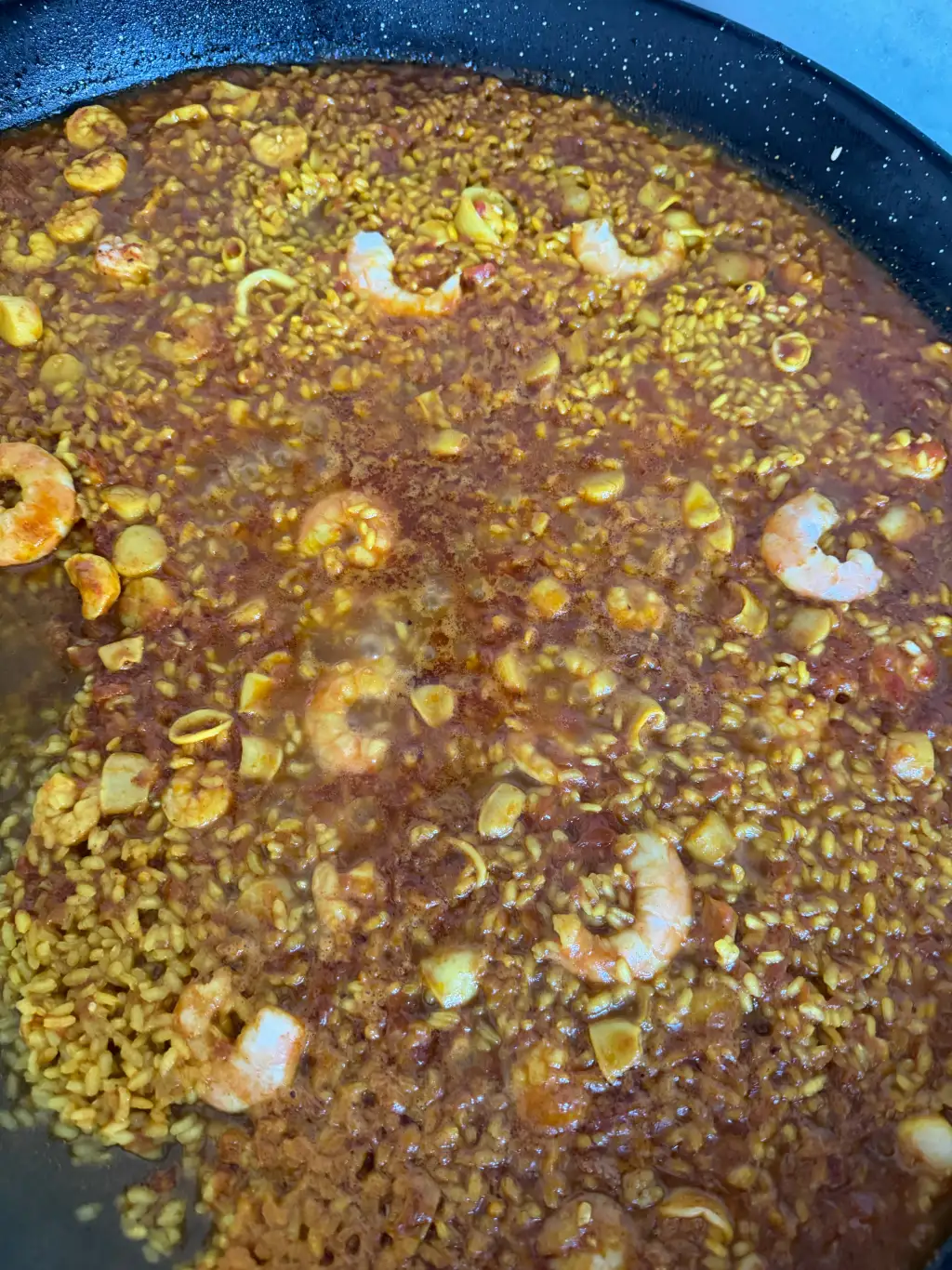
    Paella mid-cooking with broth still visible around the rice and shrimp

    No:

    • No chorizo. (See the next section. This is the one that brings out feelings.)
    • No onion. The water-and-rice ratio doesn't tolerate the moisture onion releases.
    • No garlic in the sofrito of paella valenciana, though garlic is fine in seafood paella and in fideuá.
    • No peas. Peas are a 20th-century tourist addition.
    • No seafood (in valenciana specifically).

    This list is more than a recipe. It's how Valencians draw the line between "paella valenciana" and "rice cooked in a wide pan." The first is a regional dish with a defined identity. The second is what most of the world eats and calls paella.

    We respect the line. When a host asks us for paella valenciana, we make valenciana. When a host asks for "a paella with everything in it," we make mixta and give it the right name.

    The "no chorizo" rule, and why Spaniards take it personally

    This is the section every "what is paella" article has to write, and most of them get it half right.

    Traditional paella does not contain chorizo. Not in valenciana. Not in marisco. Not in mixta as it's made in Spain. Adding chorizo turns the dish into something else, fine, possibly delicious, but not paella in the traditional Spanish sense. The smoky, paprika-heavy, fatty profile of chorizo dominates the rice. Saffron, which is the soul of paella, gets buried.

    The Internet had its biggest paella moment in 2016 when a celebrity chef posted a recipe with chorizo, and Spanish Twitter erupted. The reaction wasn't just food snobbery. It was about a regional dish whose identity gets diluted every time it crosses a border.

    Why does this matter? Two reasons.

    First, paella is a regional identity dish. Valencia takes paella seriously the way Naples takes pizza seriously, or Texas takes barbecue seriously. The recipe is part of how the region understands itself. Adding chorizo to paella is like adding pineapple to a Neapolitan pizza, there's a version of the world where it's fine, but it's not the version Naples is in.

    Second, chorizo and saffron don't actually work together. This is the unromantic answer. Chorizo's pimentón de la Vera (smoked paprika) is the same flavor profile as the paprika already in the paella. Doubling it crowds out the saffron, which is more delicate and more expensive. The result is a smoky rice that tastes like its cheapest ingredient, not its rarest.

    We don't put chorizo in our paella. We do put it in our charcuterie boards, in our chorizo a la sidra, in our morning eggs at home. Chorizo is one of our favorite ingredients on earth. It just isn't a paella ingredient.

    If you've had paella with chorizo somewhere and loved it, that's fine, that caterer has decided the customer-facing simplicity matters more than the regional definition, and there's a defensible position there. We've made the other call.
    Socarrat: the burnt-rice layer that separates real paella from rice with toppings

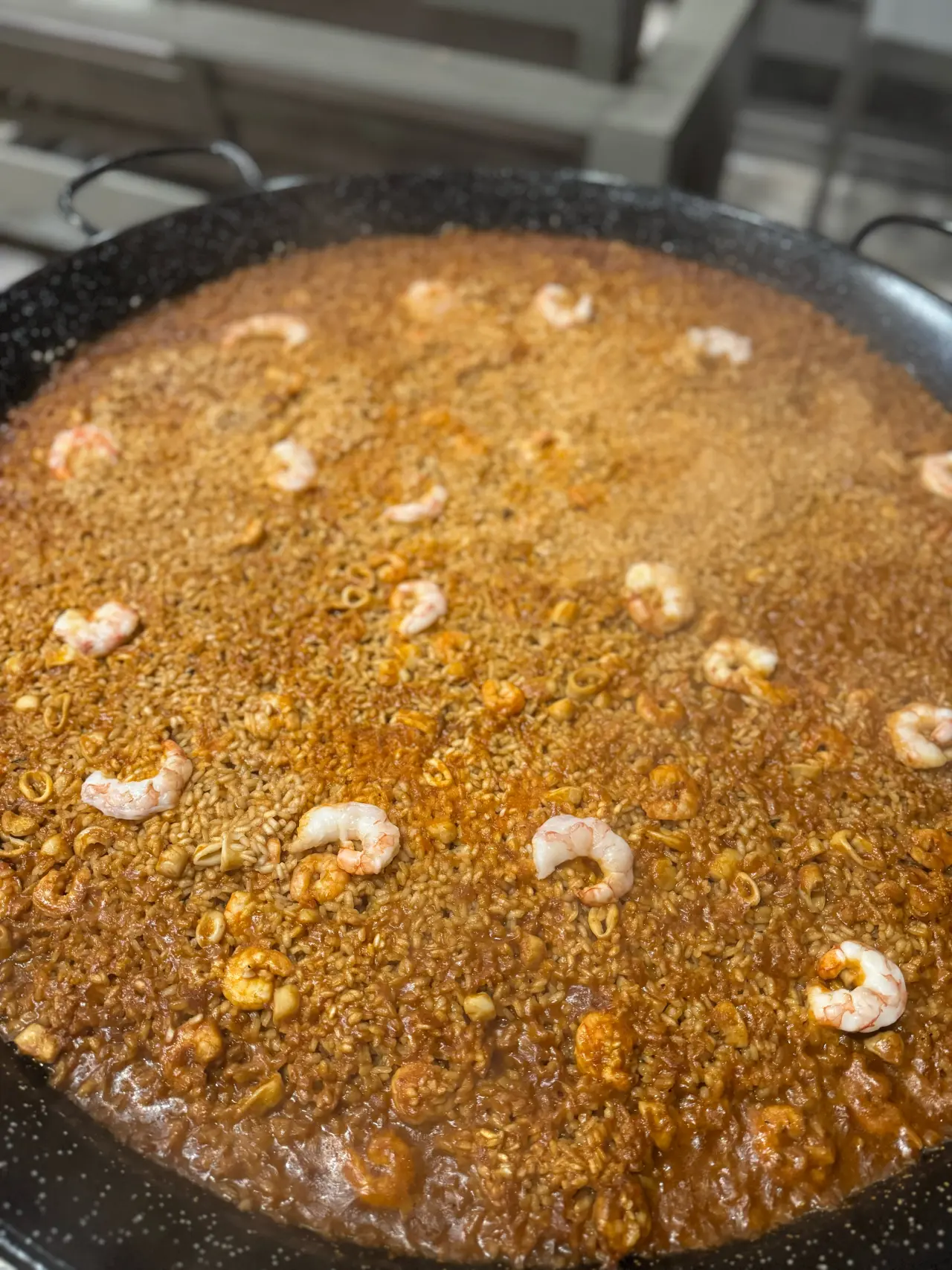
    Socarrat is the layer of caramelized rice at the bottom of the paellera, the dark, crisp crust that forms when the broth has fully evaporated and the rice continues cooking against the hot pan. In Valencia, the socarrat is the best part of the paella, scraped from the pan with a spoon and eaten last.

    You cannot get socarrat from a paella that arrived already cooked. The socarrat happens in the final two minutes, a controlled, intentional toasting that requires the cook to listen to the rice, smell for the moment when sugar starts to caramelize, and pull the heat at the exact right second. Reheat that paella and the socarrat goes from crisp to leather. Hold it under a heat lamp and you get something worse.

    Top-down view of paella showing the caramelized socarrat layer at the bottom of the pan

    A returning client of ours told us, after we'd done her parents' birthday, that her family had ordered paella from another Houston caterer for years, and it had always arrived cold. She thought that was just how catered paella worked. The first time we cooked the paella live in front of her family, she said: "Wait, you cook it here? It's hot? I've eaten cold paella my whole life." That moment is what socarrat protects. You can't deliver socarrat. You have to be in the room when it forms.

    This is also the reason paella catering is structurally different from most catering. Cold-delivery and chafing-dish formats work fine for dishes that hold up to reheating. Paella isn't one of those dishes. The rice is the entire point, and the rice goes from perfect to overcooked in the time it takes to drive across town.

    If you're thinking about a paella event in Houston, the format matters as much as the menu. Live paella catering in Houston is what we do, because socarrat is what we want our guests to taste.

    Talk to us about your event

    If you're planning a Houston event and want paella cooked the way Valencia cooks it, send us a note. We'll come back within one business day.

    How real paella is actually cooked (open flame, paellera, no lid, no stirring)

    The technique is mostly about restraint. The cook does fewer things to the pan than the cook of a risotto does. Once the rice goes in, the rules tighten:

    Open flame, not a stovetop. The paellera is wider than a standard burner. Even heat across the whole surface comes from a propane ring burner or a wood fire, not from a single point of heat under the center.

    No lid. Paella is open to the air for the entire cook. Steam escapes. The top layer of rice bakes lightly. Lidded rice is a different dish.

    Live paella valenciana cooked over open flame at a Cantábrico event in Houston

    No stirring after the rice goes in. The cook stirs the sofrito (oil, tomato, paprika, sometimes garlic) at the start. The cook adds the broth and the rice. After that, no stirring. The rice has to settle into the pan and form a single even layer, so every grain has access to the same liquid. Stirring breaks that layer and ruins the texture.

    Listening for the socarrat. In the last two minutes, the broth is gone, the rice is fully cooked, and a sugar-and-starch caramelization starts at the bottom of the pan. The cook listens for the change in sound, the sizzle gets quieter as the liquid leaves, then a faint crackle as the rice toasts. That's the socarrat. Pull the pan off the heat thirty seconds too late and the socarrat goes from crisp to burnt.

    Resting. Three to five minutes, off the heat, sometimes covered loosely with foil or a clean kitchen towel. The rice finishes settling. The cook does not touch the pan during the rest.

    This is the live-cook approach we take at every event. The technique is the dish. Skip any of these steps and you'll get rice with paella ingredients in it, which is a perfectly nice food but isn't the thing the word "paella" was trying to describe.

    Fideuá: paella's noodle cousin from Gandía

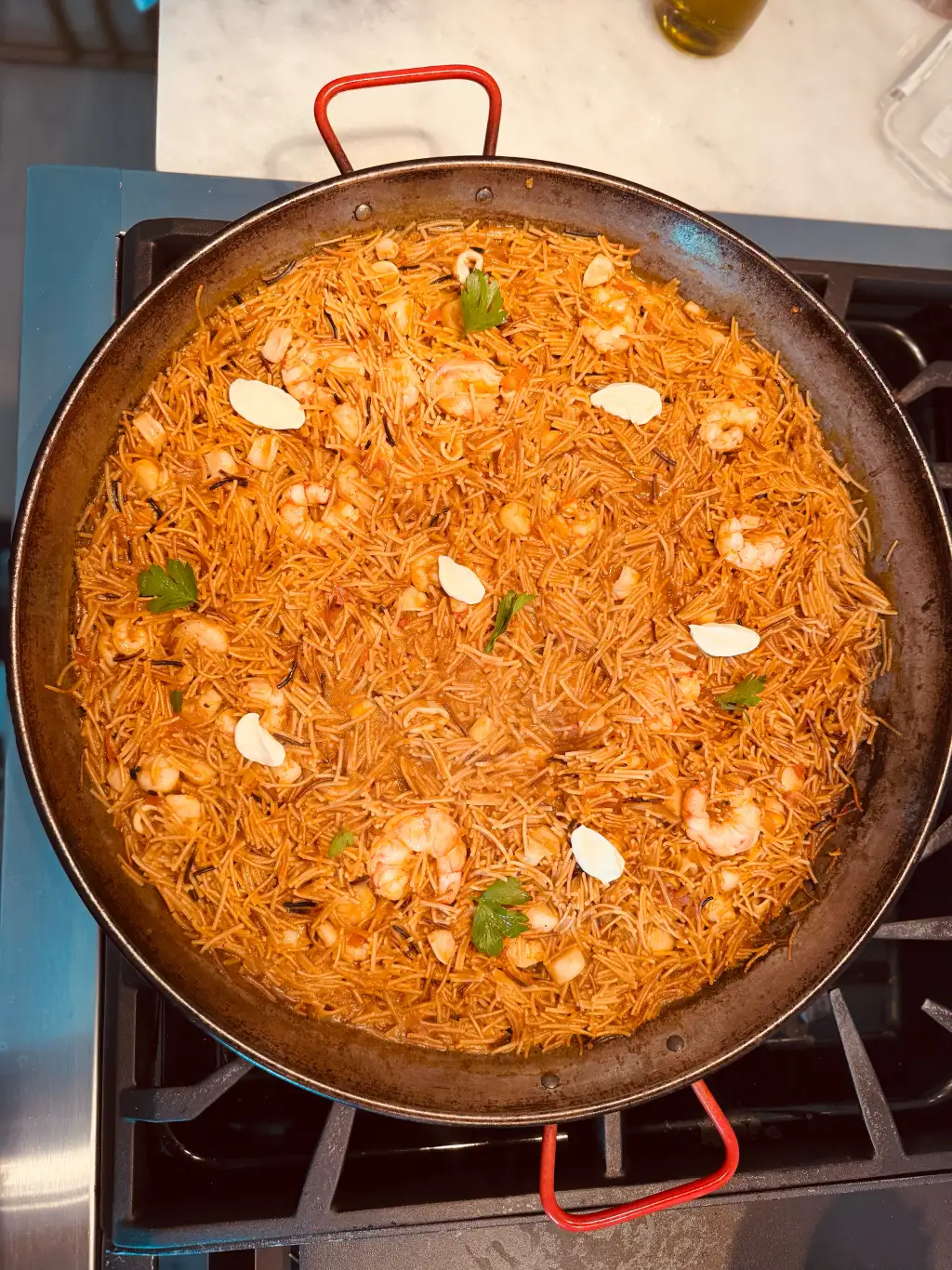
    Fideuá is paella made with short noodles instead of rice. The dish comes from Gandía, a coastal town an hour south of Valencia, and it's traditionally cooked in the same paellera, with the same technique, just substituting fideo (a short toasted vermicelli) for the rice.

    Top-down view of fideuá, paella's noodle cousin, with shrimp and garlic in a paella pan

    Origin story: Gandía was a fishing town in the 1960s, and a cook named Gabriel Rodríguez Pastor (or, in another telling, an older fishing-boat tradition) wanted seafood paella that the boat's captain wouldn't eat all of before the rest of the crew got a turn. Noodles, the legend goes, made the dish less appealing to the captain, who only liked rice. The crew got their share. Fideuá was born.

    Whatever the actual origin, fideuá has been a regional Valencian dish for sixty years, and it does for noodles what paella does for rice: an open-pan, broth-and-saffron technique that produces a similar caramelized layer at the bottom and a similar shared-table presentation. The aioli sauce served alongside (the only "topping" allowed) is a Catalan touch that makes the dish work.

    We mention fideuá here because it's the most common Valencian dish that Americans don't recognize but immediately love when they try it. It also helps clarify what paella is: when you see fideuá and see paella side by side, the technique is obviously the same and the rice/noodle swap is obviously a variant, not a betrayal, the way chorizo is in some Valencian eyes. Sometimes a tradition makes its own variants.

    For Spanish food catering in Houston that mixes paella with fideuá or Spanish tapas catering in Houston, that's our usual format. The two dishes get along.

    When NOT to hire a paella caterer (a soft framing)

    This is the section we put in every blog post and service page. Two friends told us once that we'd be a better business if we told people what we don't do, fewer wasted inquiries, more bookings from people who actually want what we make. They were right.

    You're better served by a different caterer if:

    • The format you need is delivery-only, with no on-site cooking. Paella catered the right way is a live-cook event. We can deliver paella, but the paella we'd deliver isn't the same product as the paella we cook live, and we'll tell you that before you book.
    • Your reference for paella is the version that arrives cold from a different caterer. That's a different category of product, and it's priced differently. If your budget and expectation are calibrated to that, we're not the upgrade you're looking for, we're a different conversation.
    • You want fusion. Sushi-and-paella stations, taco-and-paella stations, mini-paella-cones-with-quinoa. Other Houston caterers do these well. We don't.
    • The event is under 12 guests. Twelve is our soft minimum, not a hard cutoff, but the live-cook setup overhead doesn't always make sense for smaller groups.

    We're not the only authentic Spanish caterer in Houston. Other people in this city cook Spanish food, and some of them are friends. Our claim is the food, not a title.

    Frequently asked questions

    Is paella from Spain or Valencia specifically?

    Both, depending on the level of detail. Paella is a Spanish dish, and most Spaniards eat it as a national rice dish. But paella valenciana, the original traditional recipe, is from Valencia, and Valencia treats it as a regional identity dish. Saying paella is from Spain is true at the country level. Saying paella is from Valencia is true at the regional level, and is more accurate when you're discussing the original recipe.

    Does real paella have chorizo?

    No. Traditional paella, valenciana, marisco, or mixta as cooked in Spain, does not contain chorizo. Adding chorizo turns the dish into something else. Some American restaurants and home cooks do add it; that's a different version, defensible on its own terms but not traditional.

    What is socarrat and why does it matter?

    Socarrat is the layer of caramelized, slightly crisp rice at the bottom of the paella pan. It forms in the last one to two minutes of cooking, when the broth has evaporated and the rice continues cooking against the hot pan. In Valencia, the socarrat is considered the best part of the paella. You cannot get socarrat from a paella that arrived pre-cooked, which is why live-cook is the format that matters.

    Can paella be vegetarian?

    Yes. Modern Spanish cooks accept vegetarian paella, though strict purists from earlier generations would have called it a different dish. Common ingredients: artichokes, asparagus, white beans, green beans, peppers, tomato, paprika, saffron, Bomba rice. Same socarrat, same technique, same flavor depth.

    Why is paella yellow, is it always saffron?

    Real paella's color comes from saffron and from sweet paprika (pimentón). Saffron threads release a deep yellow when soaked in warm broth; paprika contributes orange. Some non-traditional recipes use turmeric or food coloring as a saffron substitute, easy to spot once you know what real saffron-rice tastes like, which is more floral and less metallic than turmeric.

    What's the difference between paella and risotto?

    Different rice, different technique. Risotto uses Arborio or Carnaroli rice and a stovetop method, stirred constantly, broth added in stages, finished with butter and parmesan. The texture is creamy. Paella uses Bomba or Calasparra and an open-pan method, no stirring after the rice goes in, broth absorbed in one stage, finished with a dry caramelized layer (socarrat). The texture is dry, separate, never creamy. Risotto is Italian; paella is Spanish.

    Can you make paella without seafood?

    Yes. Paella valenciana, the original recipe, does not contain seafood. It's made with chicken, rabbit, beans, and saffron. Most Americans associate paella with seafood because paella de marisco (the seafood version) became the most common version in tourist Spain, but it's the variation, not the original.

    Is paella always made in a paella pan?

    Yes. The dish is named after the pan. The wide, shallow shape is part of the technique: maximum surface area for the rice to cook in a single layer, with even heat from below and air access from above. A pot or stockpot would produce a different dish. If the pan was different, the rice would be different, and the result wouldn't be paella.

    Let's talk about your next event

    If you've never seen paella cooked live, open flame, paellera, the smell of saffron filling the room, that's how we serve it in Houston. Paella valenciana, paella de marisco, paella mixta, paella vegetariana, fideuá. Every recipe respects the tradition without exception.

    Phone: 713.878.7785 (Cristina) · 713.562.1300 (Blanca)

    Email: info@cantabricosf.com

    About the authors

    Blanca Bernabéu grew up in Barcelona, on the Catalan coast. Cristina Fernández grew up in Asturias, on the Cantabrian Sea. Cristina spent twenty years in banking before they started cooking professionally for events in 2024. Together they run Cantábrico, a Spanish catering business covering Houston and eight surrounding cities. The food on their menu is from across all of Spain; their roots are northern.